
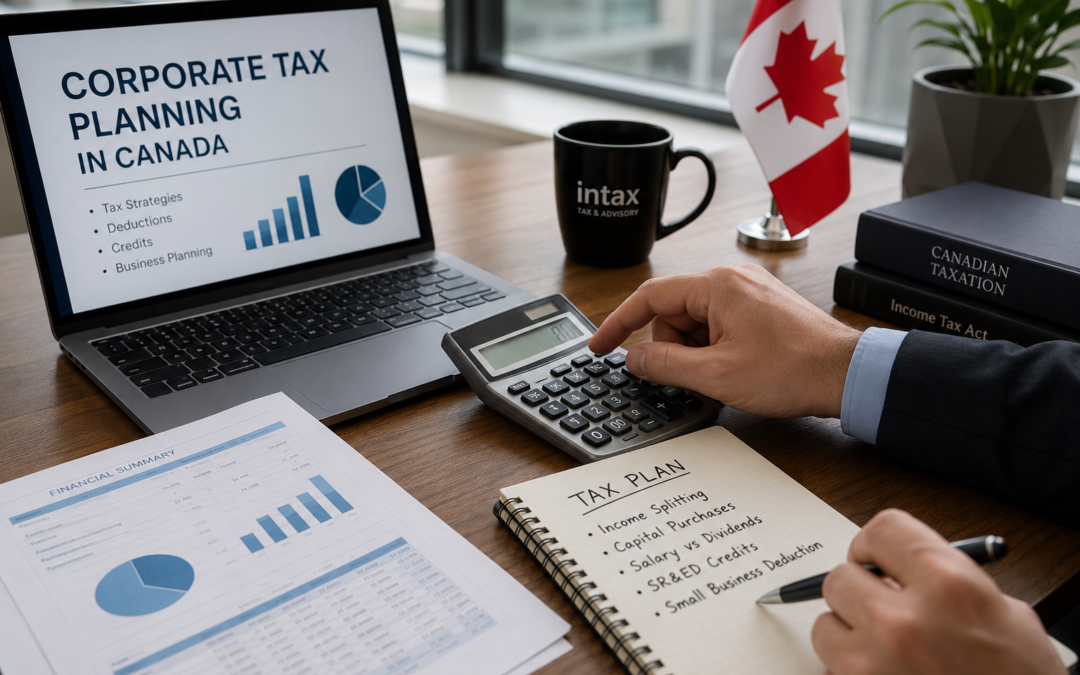
Owners of incorporated businesses often only think about corporate tax planning in Canada once a year, right before their T2 is due. CRA lets you deduct the actual business-use percentage of costs like a cell phone bill, yet most owners default to a flat guess instead of calculating the real number. This guide walks through the business tax reduction strategies Canada‘s tax code actually allows: timing purchases, structuring compensation, and claiming credits that owners routinely skip. By the end, you’ll have a concrete list of moves worth bringing to your accountant before your next fiscal year-end.
What Corporate Tax Planning in Canada Actually Involves
The year-round process of organizing your income, expenses, assets, and compensation to ensure that your company pays the lowest rate permitted by Canada’s Income Tax Act is known as corporate tax planning.
This differs from tax filing. Filing your T2 corporate return each year is a compliance requirement. Corporate tax planning in Canada benefits businesses because it happens before transactions occur, not after.
This is crucial because decisions affecting your tax bill—such as the timing of purchases, owner compensation, or establishing a holding company—are difficult to reverse once your fiscal year end, the date of your payments to yourself, doing or not doing a holding company, etc) once your fiscal year ends. Common planning areas include:
- Timing of income and capital purchases
- Salary versus dividend mix for owners
- Passive investment income held inside the corporation
- Eligibility for provincial and federal tax credits
Get this right, and you keep more after-tax cash to reinvest instead of remitting. Next: the single biggest lever most CCPCs have — the Small Business Deduction.
The Small Business Deduction Is Your Biggest Lever
The Small Business Deduction (SBD) cuts the federal corporate tax rate from 15% to 9% on the first $500,000 of active business income for a qualifying CCPC.
Every province adds its own rate on top. In Alberta, the combined small business rate is 11% (2% provincial plus 9% federal) on that first $500,000, against a 23% combined general rate above it — one of the lowest small-business rates in the country. Alberta’s February 2026 budget left both figures unchanged, so these are the numbers to plan around right now.
| Income band | Combined rate (Alberta, 2026) |
| Active income up to $500,000 (CCPC, SBD applies) | 11% |
| Active income above $500,000 | 23% |
Small business tax planning starts with confirming you actually qualify as a CCPC every year — a status based on Canadian control and residency, not just where you’re incorporated. That’s a real, ongoing gap between an 11% and 23% rate on the same dollar of income. Losing SBD eligibility by accident is one of the most expensive mistakes a growing corporation can make — which is exactly what the next section covers.
Not sure whether your corporation is still capturing the full Small Business Deduction? Intax’s free consultation reviews your structure at no cost.
Watch the $50,000 Passive Income Trap
Once a CCPC’s passive investment income passes $50,000 in a year, CRA reduces the $500,000 Small Business Deduction limit by $5 for every $1 above that threshold.
Businesses that reinvest their profits rather than spend them are subject to the Adjusted Aggregate Investment Income (AAII) rule. According to the Canada Revenue Agency’s T2 Guide Chapter 4, interest, rent, portfolio dividends, and taxable capital gains within the corporation are all included. The SBD totally vanishes at $150,000 in passive income, causing active income to rise from 11% to 23%. How do businesses handle this?
- Realize capital losses the same year as gains, instead of carrying them forward.
- Route surplus cash through an RRSP top-up or a properly structured holding company
- Time large one-off gains around a lower passive-income year
Tax optimization for corporations here isn’t about avoiding investment income. It’s about knowing which fiscal year to book it in. Miss this threshold by accident, and the annual tax burden can reach five figures. Timing matters just as much on the expense side, which is where capital purchases come in.
Time Your Capital Purchases Around Your Fiscal Year-End
Buying and putting eligible equipment into use before your fiscal year-end lets you claim Capital Cost Allowance sooner, directly reducing this year’s taxable income.
Capital Cost Allowance (CCA) is Canada’s version of depreciation — different asset classes are deducted at different annual rates. Some CCPCs can also fully expense certain equipment in the year of purchase under the immediate expensing rules, though the enhanced first-year rate phases down for property acquired after 2027 (Canada Revenue Agency, 2026). A vehicle or laptop bought and in service on December 30 gets a full year’s head start on deductions compared with the same purchase made on January 2. Before year-end, it’s worth reviewing:
- Equipment or technology upgrades already planned for next fiscal year
- Confirm that vehicles are used more than 50% for business purposes.
- Whether an asset qualifies for immediate expensing versus a standard CCA class
This single timing decision can shift the associated tax deduction for six- and seven-figure equipment purchases from one tax year to another. Once your capital side is planned, the next question is how you take money out of the corporation.
If you’d like a second opinion on how your current deductions stack up, Intax offers a free 30-minute corporate tax planning review for Alberta businesses.
Salary, Dividends, or Both: Structuring Owner Compensation
How you pay yourself from your corporation — salary, dividends, or a mix — changes your personal tax bill, your RRSP room, and your CPP contributions, not just your corporation’s tax rate.
Salary is deductible to the corporation and builds RRSP contribution room. Dividends are taxed personally but come with a tax credit for tax already paid inside the corporation. Providing legitimate wages to a husband, wife, or grown child who genuinely works in the business can shift income into a lower personal bracket — but CRA’s Tax on Split Income (TOSI) rules restrict paying dividends to family members who aren’t actively involved.
- Salary: builds RRSP room, deductible to the corporation, subject to CPP
- Dividends: no RRSP room, taxed personally with a credit, no CPP
CRA compliance strategies entail recording market-rate compensation and actual hours worked for any family member on payroll; TOSI reviews particularly focus on thin documentation. In addition to costing money, a poor mix invites the very type of CRA review that most owners are attempting to avoid. The next frequently overlooked component is R&D credits.
Claim the R&D Credit Most Owners Assume Doesn’t Apply to Them
The Scientific Research and Experimental Development (SR&ED) program refunds up to 35% of qualifying R&D costs for CCPCs on the first $3 million of expenditures, even for businesses that aren’t yet profitable.
SR&ED isn’t limited to labs. Solving a genuine technical problem — a manufacturing process, a custom software build, a new agricultural technique — can qualify if it involved real uncertainty rather than routine work. As of April 1, 2026, CRA added a pre-claim approval process: eligible businesses can submit a project before spending the money and get a determination back within eight weeks, valid for up to three years. Common qualifying activities:
- Custom software with unresolved technical problems
- Process or product experimentation in manufacturing, energy, or agriculture
- Prototype development involving genuine trial and error
Businesses that assume SR&ED is only for tech startups routinely leave five- and six-figure refundable credits unclaimed. Bringing this into a year-round plan — not a once-a-year scramble — is the real shift most owners need to make.
Build a Year-Round Tax Calendar, Not a Year-End Scramble
Corporate tax planning should be a quarterly practice aligned with your fiscal year instead of a one-time meeting a month before T2 is due.
You can take action on your findings by reviewing SBD eligibility, passive income levels, and planned purchases on a quarterly basis. There is no opportunity to discuss financing or delivery when discussing equipment purchases over the phone on December 28. A simple starting structure:
- Q1: Confirm prior-year AAII and SBD eligibility
- Q2–Q3: Time major purchases and review salary/dividend mix
- Q4: Finalize capital purchases before fiscal year-end; check SR&ED-eligible projects
This is where corporate tax planning Canada businesses is treated as strategic advisory work, which looks different from a firm that just files what you hand them in April. Bringing a tax advisor into decisions as they happen — not after — is what actually separates the businesses that keep more of what they earn.
Conclusion
The three areas where Alberta CCPC owners most frequently leave money with the CRA rather than the business are the Small Business Deduction, the $50,000 passive income threshold, and SR&ED. In Canada, actual corporate tax planning takes place prior to year-end rather than during tax season. Make an appointment for a free 20-minute call with Intax’s Calgary team to find out what you’re currently missing if you incorporated within the last few years and haven’t had your structure reviewed.
Frequently Asked Questions
What is corporate tax planning in Canada?
It isn’t a scramble you pull off once a year. It’s an ongoing, everyday strategy—smartly managing your income, expenses, and how you pay yourself so you legally keep as much money in your business as possible.
How much can the Small Business Deduction (SBD) save my corporation?
A lot. A qualifying Canadian-Controlled Private Corporation (CCPC) pays just a 9% federal tax rate on its first $500,000 of active business income, compared to the 15% general rate. In Alberta, for example, that brings your combined federal and provincial rate down to 11% instead of 23%.
What happens if my corporation earns passive investment income?
Your active business tax savings can take a hit. Once your passive investment income crosses $50,000 in a tax year, the CRA reduces your $500,000 SBD limit by $5 for every $1 over that threshold. If your passive income reaches $150,000, your SBD limit drops to zero.
Do I need an accountant, or can I file my own corporate tax return?
Canadian corporate tax legislation is complex. Issues such as TOSI, passive investment income thresholds, and SR&ED eligibility often require professional guidance. A corporate tax specialist can help maximize available deductions while ensuring compliance with CRA requirements.